|
3. Hemorrhoids
Definition:
The word
hemorrhoid originates from the Greek language and is literally translated as
"blood river". They look like sponge tissue filled with blood, in which a
network of entering (arteries) and exiting (veins) blood vessels exist. The
blood vessels also penetrate the external and internal sphincter (closing)
muscle. Since in particular the internal closing muscle must be flexed in
order to lock the anus, the blood from the hemorrhoidal tissue cannot flow
out and is accumulated. So, they form a circular pad in the final intestine
and supports the sealing function of the sphincter muscles. The hemorrhoids
-in a sense- function as micro control of the anus.
If the
closing muscle relaxes with the defecation, the blood from the hemorrhoids
can flow out, whereby the nodules relax and the stool can be emptied
unhindered. If this mechanism is disturbed, the closing muscle does not
relax completely and the blood remains accumulated in the tissue. Then the
increased nodules present an obstacle and will be pressed in the anal
channel by the defecation.
Causes:
· Predominantly
sitting inactively and lack of movement in the modern office environment
·Obesity
·Low
Fiber diet, low fluid intake and de-hydration
·Constipation,
extended pushing and long toilet meetings (newspaper reading)
·Over-consumption
of laxatives
·Genetic
weakness of the connective tissue
·Hormonal
changes during and after pregnancies
·Diarrhea
with damage of the hemorrhoidal pads
Schematic representation of the anatomy of the final intestine:
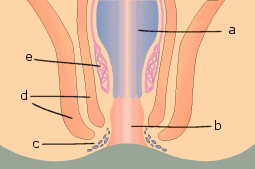
a)
final intestine,
b)
anal channel,
c)
anal edge veins
d)
sfincter muscles,
e)
hemorrhoids
The reasons
specified above lead -in time- to the enlargement of the hemorrhoids. This
enlargement alone does not constitute an illness. When the typical symptoms
and complaints become common, one can speak of the illness.
Symptoms:
Depending on
size and indications, the hemorrhoidal illness can be separated into four
stages.
Stage 1
The hemorrhoid is neither visible nor can be felt by examination. The main
symptom is the light red blood in the stool. Pain does not exists.
Occasionally, it will itch and will feel like the existence of a foreign
object in the final intestine.

Stage 1
Stage 2
The hemorrhoidal tissue can be pushed out during defecation while pushing.
However, they slide back inside immediately after. In addition to visible
bleeding, itching, burning sensation, leaking as well as pain is present
with the defecation.

Stage 2
Stage 3
The hemorrhoidal tissue does not retract by itself but can
manually be pushed back in. The bleeding becomes less since the mucous
membrane tissue which surrounds the hemorrhoids begin to thicken and harden
and is therefore less sensitive in to injuries. Pain, itching and leaking
increase which can lead to eczemas at the surrounding anal skin. Occlusion
in the hemorrhoidal veins can occur, which leads to very painful thrombosis.

Stage 3
Stage 4
This stage is called fixed anal prolaps. The hemorrhoids are now constantly
outside and cannot manually be pushed back in any more. The anal mucosa is
pushed inside out and leaks constantly. This causes irritation of the skin
and can lead to unpleasant eczemas and infections. Bleedings are rare but
involuntary defecations may occur. In time, ulcers may form, choked tissue
or necrosis may occur due to pinched blood vessels which are extremely
painful.

Stage 4
back
|
Home
| forward
AAnal
diseases - still a topic with taboo |
Anatomy
of the final intestine |
How does
the illness of the hemorrhoids developed? |
How does the hemorrhoidal illness express itself? |
How
Hemorrhoids are treated? |
How is the treatment in the Proktoklinik? |
Anal
fissure |
Anal fistula / Anal abscess |
Anal thrombosis
|
Illness of the Linea Dentata |
Skin
folds (Mariscs) |
Condyloms
|
