|
8. Anal fissure
Definition:
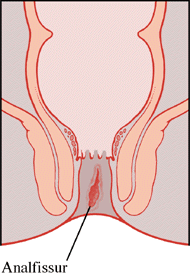
The anal fissure is a longitudinal tear/crack of the anal skin. It usually
is at about 6 o'clock position (posterior) and develops mainly due to
overstretching or irritation of the anal skin. It usually occurs from the
inside out radialy. The tear begins at the outside anal skin and ends
usually at the boundary line between anal channel and final intestine, the
Linea Dentata. In chronic cases, there often is an enlarged anal papilla
(knot) which prevents the fissure from healing up. Outside often develops a
skin tag, which has no disease value except interfering the hygiene.
Because of
the tear, the internal sphincter (closing) muscle get tensed up. This limits
the blood supply to the tissue which prevents the healing. A vicious circle
develops; the tear favors the muscle spasm which impairs the healing,
whereby the tear continues to maintain the spasm. So, it can exist for many
years, in those consequences the fissure becomes chronic. By the increased
muscle tension, favorable conditions for the emergence of hemorrhoids are
also created.
In contrast
to the acute fissure where the tear is fresh, the chronic fissure leads to a
scarring of the wound which usually is corrected only by surgical removal of
the scar tissue.
Causes:
- Hard stool
- Inflammation of the rectum and colon
- Prolonged diarrhea
- Injuries of the anal skin
- Accompaigning to hemorrhoids
Complaints:
Due to the high concentration of nerves, the anal skin is highly sensitive.
Because of this fact, anal fissures are very painful. Especially at the
beginning of the defecation, the pain is intense. Additionally, minor
bleeding, itching and burning can be felt.
Treatment:
The therapeutic principle is based on the healing of the wound by reducing
the increased muscle tonus. Therefore relaxing ointments, which content
calcium blokkers or nitroglycerin, anal dilatators or Botox injections are
used. İn case of insufficient treatment or chronic fissures healing can only
be achieved through surgical operation. Complications such as abscesses or
fistulas can occur in untreated cases.
In our clinic the fissure is totally cleaned up by use of a diod laser
included inflammated tissue and the skin tag (Laser fissurectomy). The high
tensed internal sphincter muscle will be digitally relaxated
(Sphincterolysis). Due to this procedure a leak of the anus, which is
prevalent in conventional surgery much more frequently, occurs very rarely.
After surgery, warm sitz baths are performed and the region should be
showered. Intake of drugs and ointment application has to be done for a
short time.
Picture Gallery klick here
back
|
Home
| forward
Anal
diseases - still a topic with taboo |
Anatomy
of the final intestine |
What are
Hemorrhoids actually? |
How does
the illness of the hemorrhoids developed?
How does the hemorrhoidal illness express itself? |
How
Hemorrhoids are treated? |
How is the treatment in the Proktoklinik?
|
Anal fistula / Anal abscess |
Anal thrombosis
|
Illness of the Linea Dentata |
Skin
folds (Mariscs) |
Condyloms
|
